

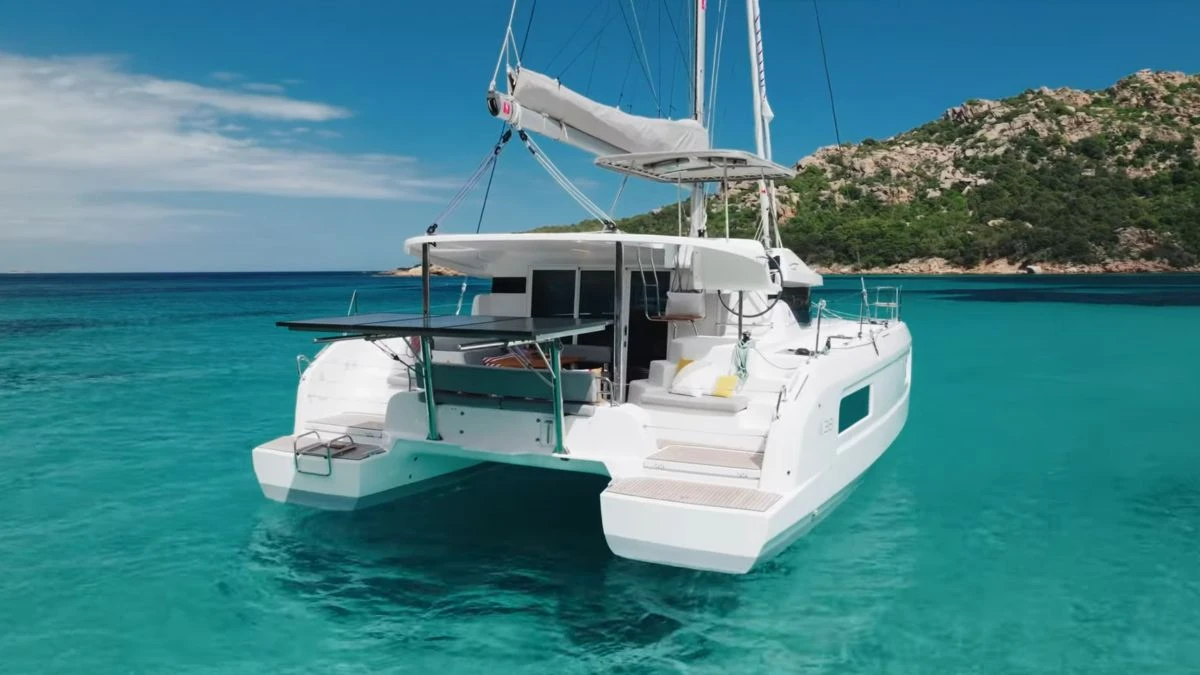
During the European Yacht of the Year trials held off the coast of Barcelona, the new Lagoon 38 was put through a rigorous assessment in challenging sea conditions. Designed as a modern, more accessible successor to the iconic Lagoon 380, this vessel aims to balance ease of handling with the high volume expected from a family cruiser. Drawing on a comprehensive sea trial and walkthrough by the Yachting World YouTube channel, this report evaluates how the catamaran performs under pressure and how its design caters to both the charter market and private owners.
Rough Weather Performance and Sailing Characteristics
The sea trial commenced in "punchy conditions" with a sunrise start to avoid a developing storm, facing 20-knot breezes and gusts reaching 27 knots. When sailing to windward directly into a significant seaway, the boat averaged between 5.5 and 6 knots, though sharper waves occasionally slowed its progress to 4.5 knots. Despite the wind noise and the typical creaking of a vessel under load, the boat's displacement helped it maintain a comfortable motion through the swell.
Performance improved notably on a broad reach, where the boat became more comfortable and reached speeds of 8 to 9 knots, occasionally hitting 10 knots when surfing down waves. The sailing setup is optimized for single-handed operation, with a single helm station that brings all lines—including the main and jib sheets—to a single winch. A self-tacking jib and a bridal system for the main sheet further simplify maneuvers, making it an enjoyable and manageable platform even for less experienced sailors.
Strategic Design for Global Charter Markets
Lagoon developed the 38 with a clear focus on the entry-level segment, aiming to offer a more affordable and simplified alternative to their larger models like the Lagoon 43. This strategy is largely dictated by market demand, as approximately 70% of Lagoon’s sales in this size category are destined for the charter industry, with the remaining 30% going to private owners. By simplifying the engineering and reducing the construction hours required, the manufacturer has managed to maintain an attractive price point while bringing new sailors into the brand.
The boat’s layout reflects this dual focus, emphasizing ease of use for charter guests and families. From the helm seat, the operator has a clear view of the ocean and easy access to all essential controls. While the single helm station setup can limit the visibility of the mainsail's trim, it provides a protected and comfortable environment for long-distance cruising.
Innovative Interior Volume and Cabin Layouts
Despite its compact 38-foot frame, the vessel offers substantial internal volume due to its wide hulls. The four-cabin version, which is the preferred choice for 70% of buyers, features four symmetrical double-sized berths. Rather than attempting to fit cramped en-suite bathrooms into every cabin, Lagoon opted for two shared, decently sized head and shower compartments, maximizing the available living space.
For private owners, the three-cabin version offers a unique configuration where the owner’s berth is positioned further forward. This design choice is intended to isolate the sleeping area from engine noise, cockpit activity, and dockside disturbances. The owner's suite is remarkably spacious for a boat of this size, featuring a vanity desk, a home-office area, and an exceptionally large shower room. Large windows and bulkhead openings throughout the interior ensure that the living spaces are flooded with natural light and well-ventilated.
Technical Specifications and Market Pricing
The Lagoon 38 is built for self-sufficiency and can be heavily customized with various options. The test vessel was equipped with a 900W solar panel array on the davits and an additional 500W on the roof to support onboard systems. In terms of capacity, the boat carries between 450 and 500 liters of both fuel and water. Its light displacement is approximately 10.2 tons, but a fully laden model equipped with air conditioning, a generator, and full tanks can reach around 13 tons on the water.
The base price for the Lagoon 38 is set at €342,000 excluding tax. however, a well-specified model like the one tested in Barcelona—which included high-end sails like a Code Zero and furling spinnaker, as well as extensive interior comfort options—can exceed €500,000. This pricing positions the 38 as a premium yet accessible entry point into the world of luxury cruising catamarans.
Photo: Lagoon
