

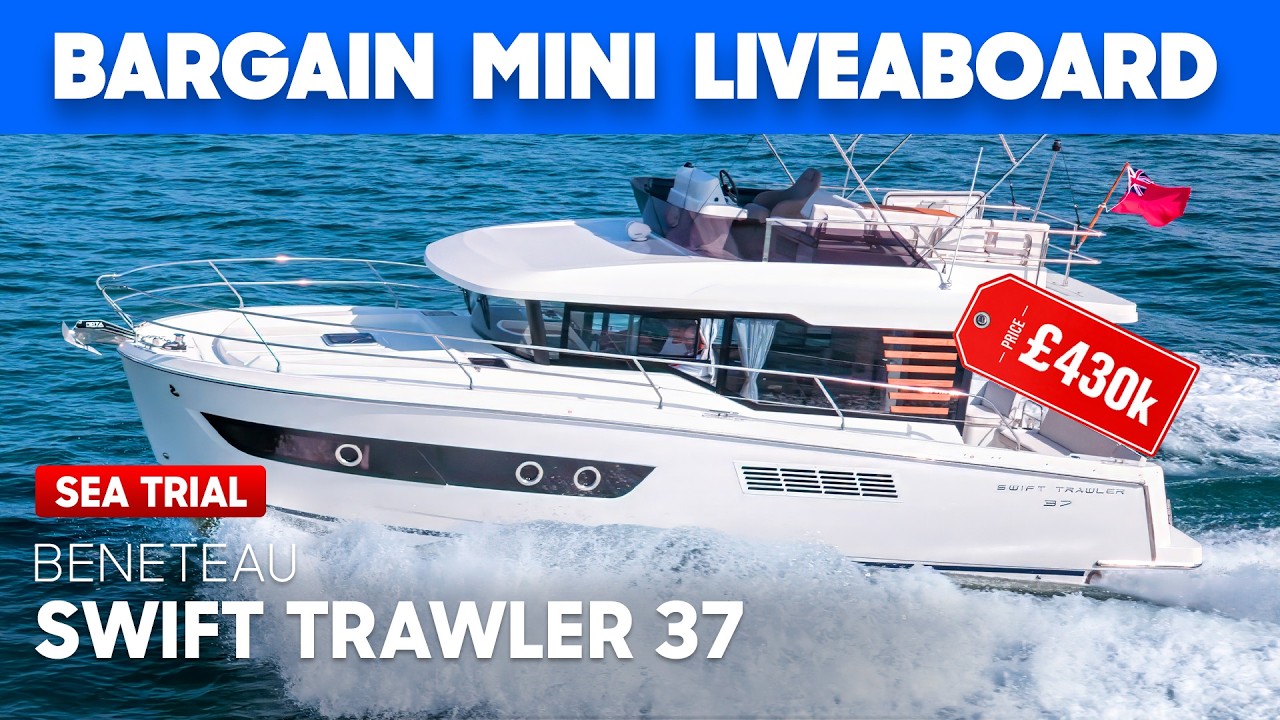
The search for the perfect liveaboard boat under 40 feet often leads to compromises, but the Beneteau Swift Trawler 37 (ST37) aims to deliver maximum value in a highly competitive segment. As the latest evolution of a model line that includes the successful ST34 and ST35, the ST37 refines the trawler concept for modern cruisers. This review, based on a detailed sea trial and boat tour by Jack Haines for the YachtBuyer YouTube channel, examines whether this boat still sets the standard for small-scale long-term living on the water.
For buyers working with a budget of around half a million pounds, the ST37 is positioned as a high-value option. The base price starts at about £305,000 ex-tax, but that version lacks many essential comforts. A more realistic on-the-water specification, including a larger engine, comfort trim, electronics pack, bow sun pads, bimini, radar, and stern thruster, is closer to £430,000 excluding VAT. Even with that increase, the ST37 still offers a lot of boat for the money.
Practical Deck Layout and Liveaboard-Friendly Storage
The ST37 keeps the asymmetric deck layout of its predecessors, with a wider and more sheltered starboard side deck that makes moving forward safer and easier. One of its biggest strengths for liveaboards is the large lazarette beneath the cockpit deck, offering generous storage for gear needed on longer trips.
The cockpit is designed for flexibility. A sliding bench can be moved back at anchor to create more floor space for a dining table, while the flybridge ladder can be pinned against the glass to open up the area further. For year-round use, the cockpit can also be fully enclosed with screens.
Beneteau has also reworked the flybridge compared with the original ST34. Instead of using the flybridge deck for tender storage with a crane, the ST37 moves tender storage to the transom with optional davits, freeing the upper deck for social use.
Flybridge and Interior Updates Focused on Comfort
The flybridge now features fixed furniture, including a dinette with a two-way backrest that can switch between travel and dining modes. The helm seat swivels to face the dining area, helping the skipper stay part of the conversation. There are no cooking facilities up top, but the area is well protected by an optional bimini that remains stable even at cruising speed.
Inside, the layout has been modernized, most notably by moving the galley to starboard. This change made room for a forward-facing navigator’s seat on the port side, so the skipper is no longer isolated. The galley is practical, with a two-burner gas hob and fiddled countertops to keep items in place at sea, although fridge space is limited.
Accommodation includes two cabins and a shared bathroom. The owner’s cabin is forward, with a large double bed, useful under-bed storage, and direct access to the bathroom. The guest cabin is a port-side bunk cabin best suited to children because of its tight dimensions. For adult guests, the saloon dinette can be converted into an occasional double berth, which is often the more comfortable option.
Performance, Handling, and Short-Handed Ease
The ST37 is built on a semi-displacement hull designed for a sweet-spot cruising speed of 15 to 17 knots. The test boat used a 400 hp Yanmar engine, with a 440 hp option available for an extra £10,000. While the larger engine may push top speed into the early 20s, the 400 hp version is considered sufficient for most owners.
At sea, the boat handles head seas well and cuts through waves effectively, though its semi-displacement nature means it can roll slightly in a quartering sea. One downside at the lower helm is engine noise, which reaches around 90 decibels at cruising speed and makes conversation difficult. On the positive side, visibility from both helm positions is excellent, and the side door next to the lower helm adds ventilation and easy deck access.
Because the ST37 uses a single shaft drive, reversing can be affected by prop walk, making marina manoeuvres more demanding. For that reason, a stern thruster is considered essential alongside the standard bow thruster. With both thrusters engaged, the boat becomes much easier to handle, almost like using a joystick.
The combination of the helm side door and adjacent boarding gate also makes the ST37 especially manageable short-handed or even solo, allowing the skipper to step out quickly and secure lines to a pontoon.
A Well-Rounded Liveaboard Package
Despite losing some deck space compared with the original ST34, the Beneteau Swift Trawler 37 remains one of the most complete packages in its size category. It balances accommodation, deck space, and cruising speed in a way that few rivals can match. For buyers seeking a dependable, functional, and value-driven liveaboard for coastal cruising and extended trips, the ST37 remains a top contender.
