

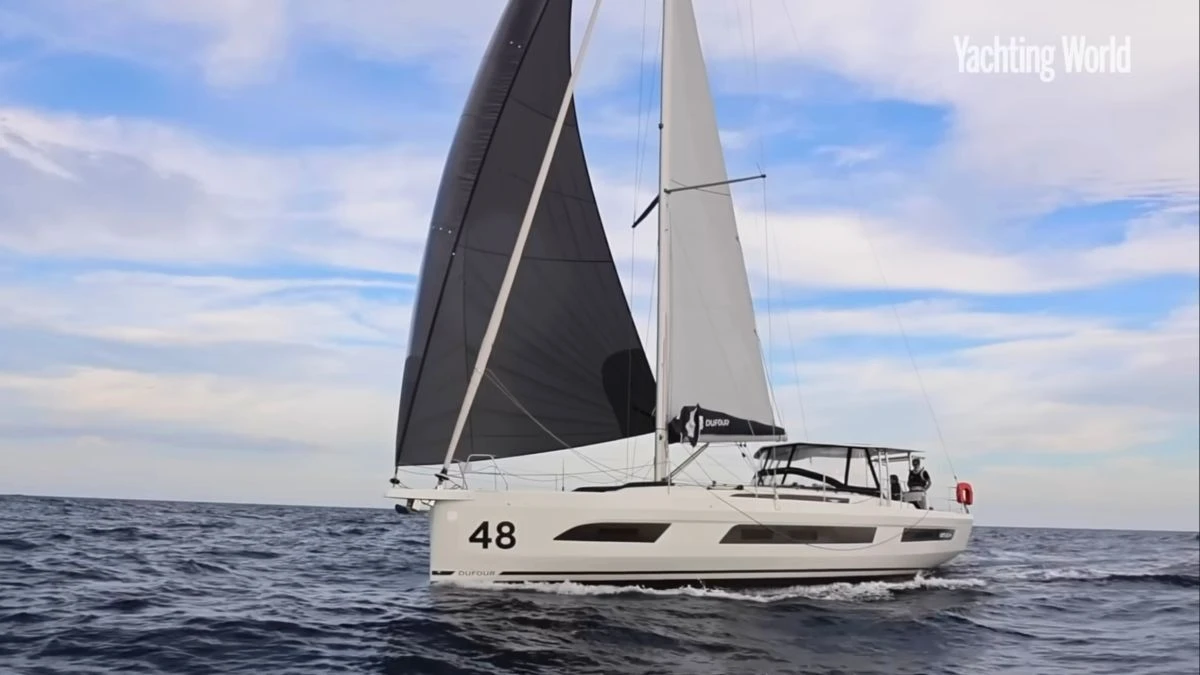
The sailing world recently gathered in Barcelona for the European Yacht of the Year 2025 trials, where the new Dufour 48 took center stage. This latest addition to the French manufacturer’s fleet represents the modern generation of cruisers, prioritizing volume, comfort, and sustainable technology. This report, based on a detailed tour and sea trial by Yachting World, explores how the Dufour 48 balances its massive proportions with innovative hybrid propulsion systems.
Alfresco Living and Smart Deck Design
One of the most striking features of the Dufour 48 is its commitment to alfresco living. The aft platform opens to reveal a signature Dufour outdoor galley, equipped with a grill, sink, and seating area. A unique and simple innovation highlighted during the trials is a removable carbon pole on the aft deck, which serves as a stand for the cockpit shower, allowing for a proper stand-up shower on the transom after a swim.
The deck layout further emphasizes relaxation, featuring a large sunbed on the bow—facilitated by the boat's modern full bow hull shape—and twin electric telescopic tables in the cockpit that can be lowered to create additional lounging space. For those seeking protection from the elements, a hard-top bimini is available as an option, which also serves a critical functional purpose for the yacht's energy systems.
Hybrid Power and Energy Independence
The Dufour 48 tested in Barcelona featured the Odyssey package, a sophisticated hybrid system developed in collaboration with Oceanvolt. This system includes a 25 kW electric sail drive that is capable of hydrogeneration while sailing. In favorable conditions, the system can generate up to 2 kW of power back into the massive lithium-ion battery bank.
To ensure autonomy, the setup is supported by 1,100 W of solar panels mounted on the hard-top bimini and a 14 kW diesel generator located under the cockpit floor. This hybrid configuration allows for approximately 4 to 5 hours of silent motoring under electric power alone, making it an ideal solution for those looking to reduce their carbon footprint without sacrificing the security of a traditional backup.
Performance, Handling and Sail Plan
At 48 feet, this is a voluminous and relatively heavy yacht, which significantly influences its behavior on the water. During the trials, the boat required at least 12 to 13 knots of wind to truly wake up and find its momentum. Once the breeze reached 19 to 22 knots, the Dufour 48 showed its strength, reaching speeds between 8 and 8.5 knots while close reaching under full main and genoa.
Due to its high sail power and volume, the manufacturer recommends a responsible reefing strategy, suggesting the first reef be taken at 15 knots of true wind. The test boat was equipped with the Ocean package, which organizes the running rigging with forward cockpit winches and two additional winches near the helm, though the tester noted that the lead for the main sheet can become heavily loaded in gusty conditions.
Interior Space, Layout Options and Pricing
The full bow design of the Dufour 48 is not just for deck space; it creates a remarkably large forward master cabin with a wide headboard and extensive ventilation. The interior is characterized by a light and airy atmosphere, though the tester noted a significant amount of creaking while under sail, which was cited as an area for potential improvement.
Dufour offers several layout options to cater to different markets:
- Forward Galley: Preferred by private owners for a more open social area.
- Longitudinal Galley: Typically chosen for the charter market (roughly 40% of sales), which allows for a larger dining table.
- Adaptable Cabins: The yacht features swing spaces that can be configured as a utility room with laundry facilities, an office, or extra heads and Pullman berths.
The Dufour 48 starts at a base price of €355,000 (excluding tax). However, the model tested in Barcelona, equipped with the extensive Odyssey hybrid system, the hard-top bimini, and various luxury packages, carried nearly €300,000 in additional options. This highlights the boat's positioning as a highly customizable platform that can range from a standard coastal cruiser to a high-tech, sustainable blue-water home.
Photo: Screenshot/Yachting World
